
Microsoft Purview: The Why, What, and How of Secure AI Adoption

For years, Microsoft Purview was often introduced through compliance: retention, eDiscovery, audit, or regulatory assessments. Those capabilities remain important, but they no longer describe Purview’s strategic role.

Today, the larger question for CIOs and CISOs is: Can the organization make its data safely usable by people, analytics platforms, copilots, and autonomous agents?

Data has spread across email, Microsoft Teams, SharePoint, OneDrive, endpoints, SaaS platforms, browsers, data platforms, and AI interactions. Some of it is well owned and protected. Much of it is not. Traditional security controls protect identities, devices, applications, and networks, but they do not always understand whether the information moving through those systems is a public brochure, a customer register, source code, a legal strategy, or acquisition material.

That is the gap Microsoft Purview is designed to address. It adds a data-centric control plane: identifying what information exists, where it is exposed, how it is used, which protections apply, and what evidence is available when something goes wrong.

Data growth is becoming a governance problem

The problem is not simply that organizations have more data. It is that information is copied, shared, exported, downloaded, synchronized, retained, and reused across an increasingly interconnected estate.
A confidential spreadsheet can move from SharePoint into email, Teams, a managed laptop, removable media, a browser upload, or an AI prompt. A stale project site can retain organization-wide access long after its original purpose has disappeared. A business-critical document can have no named owner, no classification, and no defined retention rule.
Without visibility into the information itself, security teams are forced to govern through location, application, or user identity alone. Those controls remain essential, but they cannot answer the full business question: What is the data, and should this action be allowed?


Shadow IT has evolved into Shadow AI

Employees adopt AI because it solves real problems. If approved tools are unavailable, difficult to use, or insufficiently capable, some users will turn to consumer AI services or unsanctioned enterprise applications.
The resulting risk is not theoretical. An employee may paste source code into a public chatbot, upload a contract for summarization, or provide employee information to an unapproved agent. Blanket prohibition can suppress legitimate innovation without eliminating demand. A more sustainable model combines application discovery and access controls with data classification, endpoint and browser DLP, user guidance, incident handling, and approved alternatives.
Microsoft Purview contributes the data context and policy enforcement. Application discovery and sanctioning may also depend on Microsoft Defender for Cloud Apps; identity and conditional access depend on Microsoft Entra; network-layer enforcement may require Microsoft Entra Global Secure Access or supported third-party integrations.


AI amplifies existing data weaknesses

Microsoft 365 Copilot does not normally bypass permissions. It grounds responses in information the user is authorized to access and works with existing Microsoft 365 access controls and Purview protections.
The governance issue is therefore often pre-existing access that is technically valid but operationally excessive.
A user may already have access to an old finance site through a broad group. Before Copilot, finding the relevant file might have required knowing the site existed, navigating its folders, and recognizing the document. Copilot can make that same information easier to locate and summarize.
AI did not create the permission problem. It changed the speed, scale, and usability of discovery.


Insider risk includes mistakes, not only malicious behavior

Data loss can result from deliberate theft, but also from ordinary business activity:
  • Sending information to the wrong recipient.
  • Sharing a site too broadly.
  • Copying regulated data to removable media.
  • Uploading a document to an unapproved cloud or AI service.
  • Retaining information beyond its business or legal purpose.
  • Downloading unusually large volumes of sensitive content before departure.
Effective governance must distinguish between an understandable mistake, an approved exception, repeated careless behavior, and deliberate exfiltration. This requires contextual signals, privacy-aware investigation, proportionate controls, and clear escalation to security, legal, privacy, HR, or data owners.


Regulation increasingly expects demonstrable governance

European organizations face overlapping expectations:
  • GDPR requires lawful and accountable processing of personal data, including purpose limitation, data minimization, storage limitation, appropriate security, and demonstrable accountability.
  • NIS2 establishes governance, risk-management, incident-handling, access-control, encryption, effectiveness-assessment, and reporting requirements for entities in scope.
  • DORA, applicable to covered financial entities since January 17, 2025, requires documented ICT risk management, identification and classification, monitoring, incident management, resilience testing, and third-party risk management.
  • ISO/IEC 27001:2022 requires an information security management system based on leadership, risk assessment, treatment, operation, evaluation, and continual improvement.
Purview can support controls and evidence relevant to each framework. It does not determine legal obligations, establish a lawful basis, define risk appetite, or make an organization compliant automatically.
 

Why Microsoft Purview Is the Foundation for Secure AI Adoption

Secure AI begins before the first Copilot license is assigned. It begins with the data estate.


Scenario 1: Copilot surfaces overshared content
A confidential restructuring document is stored in a site accessible through an overly broad group. Copilot respects the user’s existing access—it does not create the permission—but makes the document easier to find and summarize.
The response should combine:
  • DSPM data-risk assessments and sensitive-data discovery.
  • SharePoint access reviews, ownership, and permission remediation.
  • Interim restricted discovery or access controls where appropriate.
  • Sensitivity labels and DLP policies that restrict selected content from Copilot processing.
  • Audit and recurring reviews to detect regression.
 
Scenario 2: Sensitive content enters an unapproved AI service
An employee pastes customer records into a consumer chatbot to create a summary. Purview can help detect or block sensitive prompts, clipboard actions, or uploads in supported browser, endpoint, and network scenarios. Defender for Cloud Apps and access controls help discover and manage unsanctioned applications.
The objective is not merely to block the employee. It is to identify the business need, provide an approved alternative, explain the policy, and measure whether risky behavior declines.
 
Scenario 3: An agent accesses more data than its purpose requires
An agent created for contract support is connected to content beyond the legal department. It may inherit broad access or be grounded in unnecessary sources.
Agent governance should require:
  • A documented purpose and owner.
  • Approved grounding sources.
  • Least-privilege identity and access.
  • Data classification and DLP coverage.
  • Auditability, retention, and review.
  • Expiration or reapproval.
  • Monitoring for oversharing, unusual access, and exfiltration.
As of October 2026, Purview supports security and compliance capabilities for Microsoft 365 Copilot, Copilot Studio, several Microsoft copilots and agents, Entra-registered applications, Microsoft Foundry, and selected enterprise or browser-based third-party AI services. Coverage is not identical across applications, and some capabilities require connectors, device onboarding, browser configuration, pay-as-you-go billing, or specific license levels.
In executive terms, Microsoft Purview is a portfolio for data security, data governance, data compliance, and AI data governance. Its value comes from how the capabilities reinforce one another.


1. Understand the data

Purview classification technologies identify sensitive information through built-in and custom sensitive information types, exact data matching, document fingerprinting, trainable classifiers, and sensitivity labels.
The current Data Security Posture Management experience provides data-centric visibility into where sensitive data resides, who can access it, how it is used, whether it is protected, and where policy coverage is weak. Its scope includes Microsoft environments and supported integrations, with AI observability for applications and agents.
The Data Map and Unified Catalog address broader data-governance needs such as discoverability, metadata, ownership, and trusted use across supported data sources.


2. Communicate and apply meaning

Information Protection uses sensitivity labels to express business meaning—such as Public, Internal, Confidential, or Highly Confidential.
Labels can remain as persistent metadata and, where configured, apply encryption, usage restrictions, markings, sharing settings, or policy actions. Labels can be user-applied, recommended, defaulted, or automatically applied in supported scenarios.
A good classification model is intentionally small, understandable, and connected to handling rules. A technically sophisticated taxonomy that employees cannot interpret will fail operationally.


3. Prevent inappropriate movement

Data Loss Prevention uses classification and context to detect sensitive information and respond with auditing, policy tips, warnings, business justification, restrictions, or blocking.
Coverage can include Exchange, Teams, SharePoint, OneDrive, Microsoft 365 applications, supported endpoints, browsers, Copilot interactions, and selected cloud, SaaS, or network scenarios. Exact support varies by workload, operating system, integration, licensing, and region.
DLP should not begin as an enterprise-wide blocking program. Start with several high-value scenarios, run them in simulation, validate matches with business owners, improve user messages, and govern exceptions before enforcing.


4. Detect risky behavior

Insider Risk Management correlates relevant activities to identify patterns associated with accidental or deliberate misuse. Privacy controls include role-based access and pseudonymization.
Adaptive Protection can use risk levels to apply stronger protection to higher-risk users while allowing lower-risk users to work with less friction. Employee monitoring must be reviewed by legal, privacy, labor-relations, and—where applicable—employee-representation stakeholders before activation.
Communication Compliance supports privacy-aware detection and review of potential conduct or regulatory issues across supported communication and AI-interaction channels.


5. Retain, investigate, and prove

Data Lifecycle Management and Records Management support retention and disposition. Audit records activities for security, forensic, and compliance investigations. eDiscovery supports preservation, search, review, and export for legal matters. Compliance Manager structures assessments and improvement actions.
Together, these capabilities can create an evidence chain: policy, enforcement, activity, exception, investigation, remediation, and review.


What Purview does not replace

Purview is not a substitute for:
  • Microsoft Entra identity governance and Conditional Access.
  • SharePoint permission governance and SharePoint Advanced Management.
  • Endpoint threat protection.
  • Defender XDR, Microsoft Sentinel, or security operations.
  • Application discovery and full SaaS security.
  • Backup, disaster recovery, or DORA resilience testing.
  • Legal interpretation, records schedules, privacy decisions, or management accountability.
A mature architecture uses these controls together rather than expecting one platform to solve every governance problem.
An effective program follows five connected phases rather than a feature-by-feature deployment.
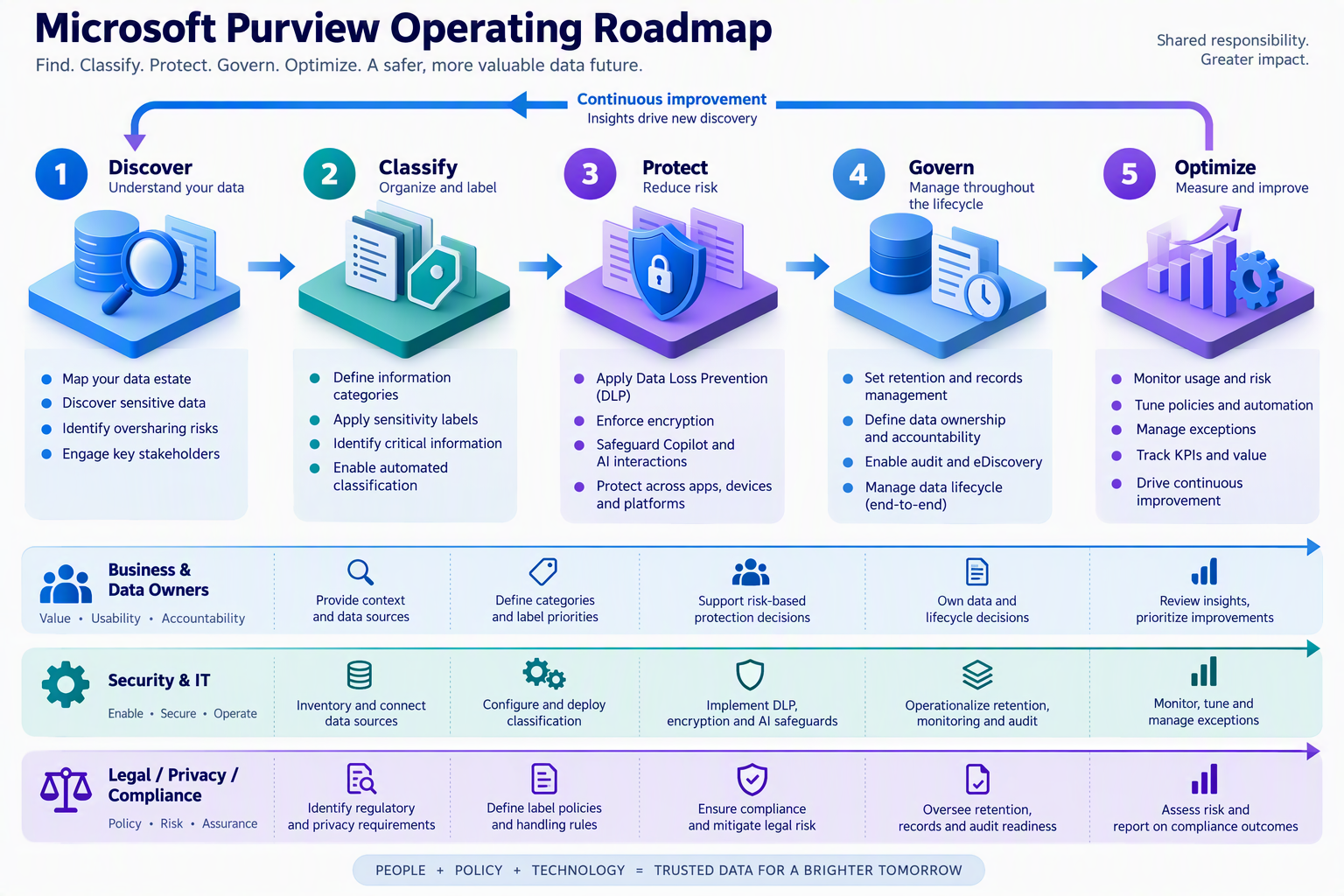
 
 
Figure 1: A practical five-phase Purview operating model: discover, classify, protect, govern, and continuously optimize—with shared accountability across business, technology, security, legal, privacy, and compliance teams.


Phase 1 — Discover

Actions: Identify critical information, scan supported locations, assess oversharing and public links, review stale or ownerless sites, understand AI usage, confirm licensing, and establish stakeholders.
Business outcome: A prioritized view of risk rather than a generic technology backlog.
Ownership: Executive sponsor, business data owners, security, IT, privacy, compliance, records, and collaboration-platform owners.
Quick wins: Assess high-risk SharePoint sites; inventory existing labels and DLP policies; identify three to five priority data-loss scenarios; assign owners to critical datasets.


Phase 2 — Classify

Actions: Define a concise classification taxonomy, handling rules, label ownership, and critical-information definitions. Pilot labels and classifiers with representative business data.
Business outcome: A shared language for protection and governance.
Change management: Test names and guidance with employees. Avoid excessive labels, unclear differences, or encryption applied so broadly that legitimate collaboration fails.


Phase 3 — Protect

Actions: Implement DLP for priority scenarios, apply appropriate labels and encryption, protect endpoints and browsers, establish Copilot and AI policies, and define approved exceptions.
Business outcome: Lower leakage risk with proportionate user friction.
Operational rule: Simulate first, validate with data owners, pilot, tune, then enforce. Every block should provide useful guidance and a support route.


Phase 4 — Govern

Actions: Approve retention and deletion rules, record ownership, define investigation roles, establish evidence requirements, document decision rights, and connect alerts to operational processes.
Business outcome: Defensible, repeatable decisions rather than isolated technical controls.
Legal, privacy, HR, and compliance teams must own sensitive decisions. Security teams should not independently define employee-monitoring purposes, records schedules, or legal-hold procedures.


Phase 5 — Optimize

Actions: Review alerts, adoption, false positives, overrides, exceptions, unlabeled sensitive data, oversharing, AI interactions, policy health, incidents, and remediation progress. Update policies as the business and Microsoft platform change.
Business outcome: Controls remain useful instead of becoming noisy, obsolete, or ignored.


  • Percentage of priority locations assessed.
  • Percentage of critical information with an accountable owner.
  • Label coverage for priority content.
  • Number of high-risk oversharing findings without an owner.
  • DLP true-positive and false-positive rates.
  • Overrides and repeat overrides by scenario.
  • Exceptions without an owner or expiration date.
  • Median time to triage high-severity events.
  • Recurrence rate after remediation.
  • AI applications and agents inventoried, approved, restricted, or retired.
  • Percentage of priority workloads covered by approved retention.
  • Business risks reduced—not merely policies created.


Common pitfalls

  1. Starting with product features rather than business risks.
  2. Treating classification as an IT-only decision.
  3. Enforcing DLP before simulation and validation.
  4. Using one detection method for every data type.
  5. Allowing exceptions to grow without ownership or expiration.
  6. Measuring policy counts instead of risk reduction.
  7. Activating insider-risk monitoring without privacy governance.
  8. Assuming Purview alone will repair SharePoint permissions.
  9. Ignoring licensing, regional availability, and consumption costs.
  10. Ending the program at go-live.


Pragmatic maturity model

  • Level 1 — Visible: Basic discovery and risk reporting.
  • Level 2 — Defined: Owners, taxonomy, priorities, and policies agreed.
  • Level 3 — Controlled: Labels, DLP, retention, and AI safeguards are operational.
  • Level 4 — Governed: Exceptions, investigations, evidence, and reviews are repeatable.
  • Level 5 — Adaptive: Risk-based controls, agent governance, measurable improvement, and continuous optimization.

Microsoft Purview is most valuable when it changes the conversation from “How do we comply?” to “How do we make our data safe, trusted, and usable?”
 
Organizations that postpone governance until after AI deployment risk making old permission, ownership, retention, and classification problems dramatically more visible. Organizations that govern first can enable copilots and agents with clearer boundaries, better evidence, and greater confidence.
The practical call to action is straightforward: identify your critical information, assess oversharing and AI exposure, select three to five high-value scenarios, assign accountable owners, and prove the operating model through a controlled pilot.
All Rights Reserved @ DOWI.dk (2025)
BACK TO TOP